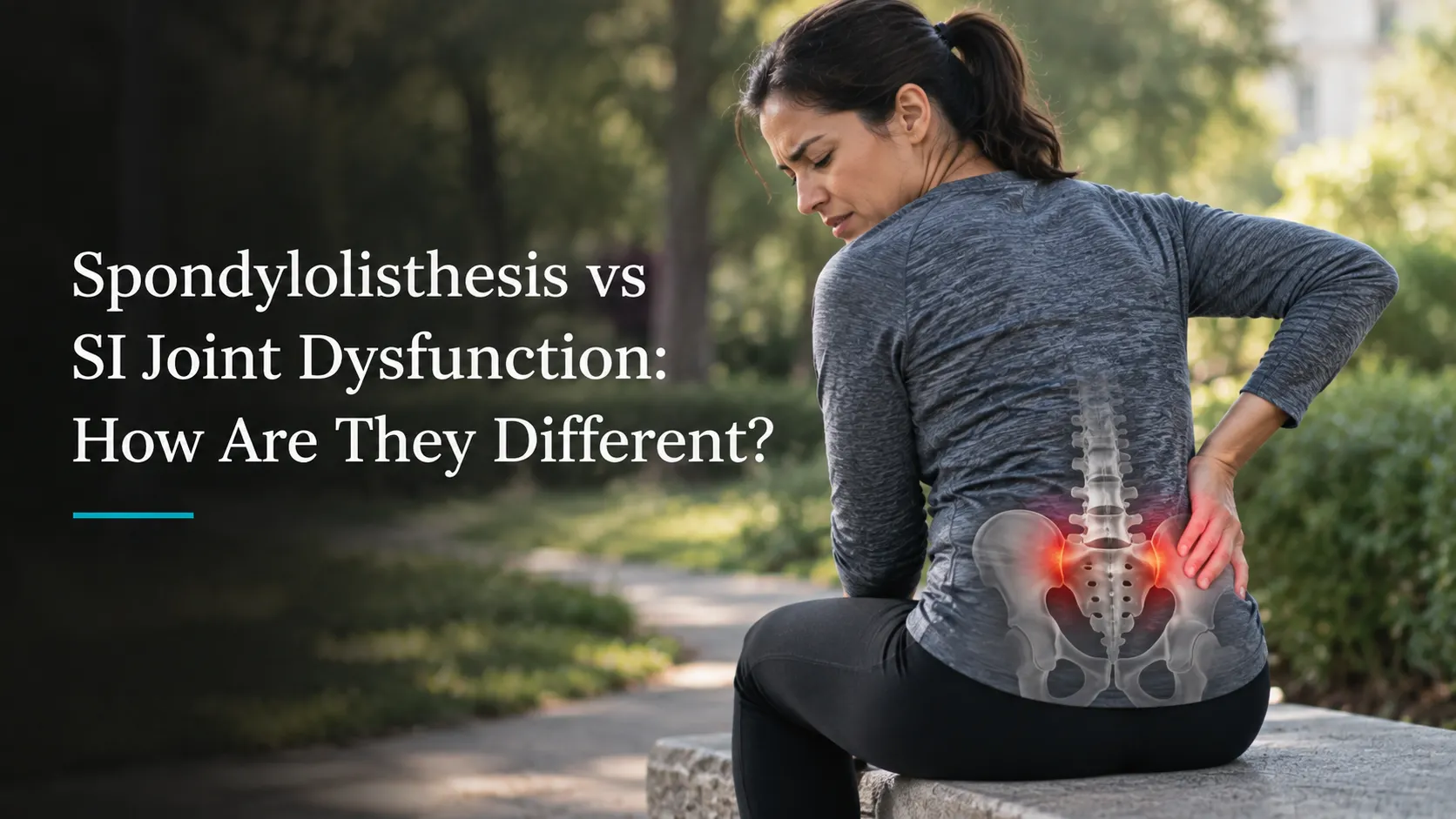
Lower back pain can be difficult to pinpoint because different conditions can produce very similar symptoms. Two common examples are spondylolisthesis and sacroiliac joint dysfunction, often called SI joint dysfunction.
Both can cause pain in the lower back, buttocks, hips, and sometimes the legs. However, they involve different structures, can have different triggers, and may require different treatment approaches.
If you have been told you may have one of these conditions, understanding the differences can help you have a more informed conversation with your doctor.
What Is Spondylolisthesis?
Spondylolisthesis occurs when one vertebra slips forward relative to the vertebra below it. It most commonly affects the lower lumbar spine.
The amount of slippage can vary, and some people have spondylolisthesis without significant symptoms. Others may develop persistent back pain, stiffness, nerve irritation, or difficulty with daily activities.
Common symptoms include:
- Lower back pain
- Tightness or stiffness in the lower back
- Pain that worsens with standing or walking
- Pain that improves when sitting or bending forward
- Leg pain
- Numbness or tingling
- Muscle tightness
- Weakness in more severe cases
The symptoms depend largely on the extent of slippage and whether surrounding nerves are being compressed or irritated.
If you are struggling with persistent symptoms, you can learn more about our back pain treatment in Lafayette.
What Is SI Joint Dysfunction?
The sacroiliac joints connect the sacrum (the lowest part of the spine) to the pelvis. There is one SI joint on each side of the body. These joints help transfer force between the upper body and the legs, normally allowing only a small amount of movement.
SI joint dysfunction occurs when either joint becomes inflamed, unstable, or irritated.
Common symptoms may include:
- Pain on one side of the lower back
- Buttock pain
- Pain around the hip or groin
- Pain that extends into the upper thigh
- Discomfort when rising from a seated position
- Pain when climbing stairs
- Discomfort after prolonged sitting or standing
- Pain when rolling over in bed
- Pain when shifting weight onto one leg
SI joint pain frequently mimics conditions such as sciatica, hip arthritis, or lumbar disc disease, which is why a thorough clinical evaluation is essential.
Spondylolisthesis vs SI Joint Dysfunction: What Is the Main Difference?
The fundamental difference lies in where the problem originates:
- With spondylolisthesis, the problem involves the alignment and stability of the vertebrae in the spine.
- With SI joint dysfunction, the pain stems from the pelvic joints connecting the sacrum to the hip bones.
| Feature | Spondylolisthesis | SI Joint Dysfunction |
| Primary Structure Involved | Lumbar vertebrae and spinal joints | Joint between the sacrum and pelvis |
| Common Pain Location | Central lower back | Frequently one-sided lower back or buttock |
| Nerve Involvement | Frequent (due to canal or foraminal narrowing) | Infrequent (though pain can radiate) |
| Leg Symptoms | Can cause shooting pain past the knee | Typically remains above the knee |
| Primary Evaluation Methods | Spinal imaging (X-rays, MRI, CT) | Physical exam maneuvers and diagnostic injections |
| Focus of Care | Spinal stability and nerve decompression | Pelvic alignment, joint mechanics, and inflammation control |
Where Does Spondylolisthesis Pain Usually Occur?
Spondylolisthesis most often causes central lower back pain that patients describe as:
- A deep ache
- Structural pressure or tightness
- Stiffness that intensifies with prolonged standing or walking
If the slipped vertebra contributes to nerve compression, symptoms may also travel down into the legs. This often resembles sciatica, presenting as sharp, shooting pain, numbness, tingling, or weakness. Many individuals feel relief when sitting or leaning forward, as these postures temporarily open the spinal canal.
Where Does SI Joint Pain Usually Occur?
SI joint pain typically feels lower down and more localized to one side compared to standard lumbar spine pain. Patients frequently point directly to the dimple or upper buttock region rather than the midline of the spine.
Pain may also radiate into:
- The buttock
- The hip
- The groin
- The upper thigh
It is uncommon for SI joint dysfunction to cause true nerve pain that radiates all the way past the knee into the foot, which helps differentiate it from typical spinal nerve irritation.
Can Both Conditions Cause Pain When Standing or Walking?
Yes. This overlap often creates diagnostic confusion.
- Walking and standing place vertical compressive force on an unstable lumbar segment in spondylolisthesis.
- Those same weight-bearing activities force the SI joint to transfer load across the pelvis, triggering pain if the joint is inflamed.
Because both conditions are aggravated by being upright, doctors rely on physical exam maneuvers, targeted imaging, and localized response tests to identify the primary culprit.
Can Spondylolisthesis Cause Sciatica?
Yes. If the slipped vertebra narrows the spinal canal or the neural exit pathways, it can compress or inflame a spinal nerve root.
This can lead to classic sciatica symptoms, including:
- Sharp, shooting pain
- Burning sensations
- Tingling and numbness
- Muscle weakness in the leg or foot
If you are experiencing radiating symptoms, we invite you to explore our targeted nerve pain treatment in Lafayette.
Can SI Joint Dysfunction Feel Like Sciatica?
It certainly can. Referred pain from an inflamed SI joint can travel down the back of the thigh, closely resembling sciatica.
However, true sciatica involves direct mechanical or chemical irritation of a spinal nerve root. Differentiating between the two is vital because treatments targeted at spinal nerves (such as lumbar epidurals) will not resolve pain originating from the sacroiliac joint, and vice versa.
How Is Spondylolisthesis Diagnosed?
Diagnosis begins with a thorough medical history and physical examination to review:
- Where your symptoms localize
- Which postures worsen or relieve your pain
- Any numbness, tingling, or loss of strength
- How long you have had symptoms
- Past back injuries or surgical history
Standing X-rays can readily confirm whether a vertebra has slipped. An MRI or CT scan may also be ordered to evaluate nerve compression, disc herniations, or spinal stenosis.
Keep in mind: The presence of a slip on an X-ray does not automatically mean it is the only cause of your pain. Imaging findings must match your clinical symptoms.
How Is SI Joint Dysfunction Diagnosed?
SI joint dysfunction can be harder to confirm on standard imaging because X-rays and MRIs do not always reveal functional joint irritation or micro-instability.
Instead, physicians use targeted physical provocative maneuvers designed to stress the SI joint and reproduce your symptoms. When these tests point to the joint, a fluoroscopic (X-ray-guided) diagnostic injection of local anesthetic into the SI joint may be performed. If the injection temporarily relieves a significant portion of your pain, it confirms the joint as a primary pain generator.
Can You Have Spondylolisthesis and SI Joint Dysfunction at the Same Time?
Yes. It is relatively common to have both conditions at the same time.
An unstable lumbar segment alters your walking mechanics, placing added stress on the pelvis and the SI joints. Conversely, a stiff or dysfunctional SI joint forces the lower spine to compensate, accelerating wear and tear.
One of our primary roles in interventional pain management is to systematically evaluate both areas and determine which structure is driving your symptoms.
How Is Spondylolisthesis Treated?
Treatment depends on the grade of slippage, nerve involvement, and joint stability.
Conservative therapies include:
- Physical therapy focused on deep core stability
- Activity modification to limit extreme extension
- Anti-inflammatory medications
- Targeted core strengthening and conditioning
If conservative measures are not enough, our team offers targeted, non-surgical treatments for chronic back pain. For instance, nerve-related leg pain can often be relieved with targeted lumbar epidural steroid injections.
You can review our full range of interventional pain procedures to see the non-surgical options we provide. For severe slippage, progressive weakness, or significant structural instability, a surgical spine consultation may also be recommended.
How Is SI Joint Dysfunction Treated?
Initial conservative management includes:
- Pelvic stabilization exercises and physical therapy
- Anti-inflammatory medications
- Sacroiliac support belts for temporary stabilization
- Modification of provocative activities
When pain persists, an image-guided SI joint injection can provide substantial therapeutic relief while confirming the diagnosis. In cases of chronic, recurring SI joint pain, advanced interventional options like radiofrequency ablation may also be considered.
Which Condition Is More Serious?
Neither condition is inherently more dangerous than the other; severity depends on your individual presentation.
A mild case of spondylolisthesis may never cause noticeable pain, while severe SI joint inflammation can be completely debilitating. Conversely, advanced spondylolisthesis with spinal canal narrowing can cause lasting nerve damage if left unaddressed.
Physicians evaluate overall severity based on:
- Intensity and duration of symptoms
- Presence of neurological deficits (numbness or weakness)
- Functional impact on work and daily activities
- Findings on physical examination and imaging
- Response to previous conservative care
Should You See an Orthopedic Doctor or Pain Management Doctor?
The appropriate specialist depends on your immediate needs:
- An orthopedic spine surgeon is ideal when there is concern for high-grade instability, fracture, deformity, or cases where surgery may be needed.
- An interventional pain physician is ideal when you want to avoid surgery, need accurate diagnostic injections, or require targeted, non-surgical relief after physical therapy and medications have stalled.
Our guide on choosing between a pain management doctor vs orthopedic doctor explains these roles in greater detail. In many cases, both specialists work collaboratively.
What If Physical Therapy Helped but the Pain Returned?
Temporary relief from physical therapy is common for both conditions. While therapy builds muscular support and restores mobility, it does not always resolve the underlying joint inflammation or structural instability.
If your pain returns, it may indicate that therapy alone cannot resolve the issue at the structural level. At this stage, a comprehensive evaluation with a pain physician can help reassess the diagnosis and provide targeted treatments that make future rehabilitation more durable.
When Should You Seek Urgent Medical Care?
While most lower back and pelvic pain can be handled routinely, certain symptoms warrant immediate emergency medical care.
Seek emergency care if you experience:
- Sudden loss of bowel or bladder control
- Numbness around your groin, buttocks, or saddle area
- Rapidly progressive leg weakness or foot drop
- Severe back pain accompanied by an unexplained fever
- Back pain resulting from major high-impact trauma
What Should You Bring to Your Appointment?
To help your physician make an accurate diagnosis, bring all relevant medical documentation to your consultation, including:
- Diagnostic imaging discs (MRI, CT, X-rays) and written reports
- Records from prior physical therapy
- Details of past injections, including dates and relief duration
- A complete medication list
- Relevant surgical notes
If you are transferring care, our guide on switching pain management doctors explains how to prepare for your first appointment.
Spondylolisthesis or SI Joint Dysfunction: How Do You Know Which One You Have?
You cannot reliably determine the cause based on pain location alone. Both conditions produce lower back, buttock, and hip discomfort, and both can be aggravated by walking or standing.
An accurate diagnosis requires combining your medical history, clinical exam, test results, imaging reviews and diagnostic interventional procedures. The goal is not merely to find an abnormality on an image, but to confirm that the abnormality matches your actual source of pain.
Comprehensive Evaluation for Lower Back Pain in Lafayette and Opelousas
At Interventional Pain Specialists, we evaluate and treat patients dealing with persistent back pain, sciatica, nerve compression, SI joint pain, and chronic spinal conditions.
Led by Dr. Albert Gros, Jr., our team provides personalized interventional pain management care across Acadiana.
- If you are near Lafayette, we invite you to visit our Lafayette clinic for a comprehensive diagnostic evaluation.
- If you live closer to St. Landry Parish, you can learn more about our Opelousas pain management clinic.
Frequently Asked Questions
Is SI joint dysfunction the same as spondylolisthesis?
No. Spondylolisthesis involves one vertebra slipping relative to another. SI joint dysfunction involves pain arising from the joint connecting the sacrum to the pelvis.
Can SI joint dysfunction cause lower back pain?
Yes. SI joint dysfunction commonly causes pain in the lower back and buttock, often more prominently on one side.
Can spondylolisthesis cause buttock pain?
Yes. Spondylolisthesis may cause lower back and buttock pain and can sometimes produce leg symptoms if nearby nerves are affected.
Can an MRI distinguish SI joint dysfunction from spondylolisthesis?
Imaging can often identify spondylolisthesis, but SI joint dysfunction may not always be diagnosed by imaging alone. Physical examination and, in some cases, diagnostic injection may be necessary.
Can you have both conditions?
Yes. A patient can have spondylolisthesis and SI joint pain at the same time. The important question is which condition is contributing most to the current symptoms.
Does spondylolisthesis always require surgery?
No. Many cases are treated nonsurgically, particularly when symptoms are manageable and there is no significant instability or neurological compromise. Surgery may be considered in more severe cases.