
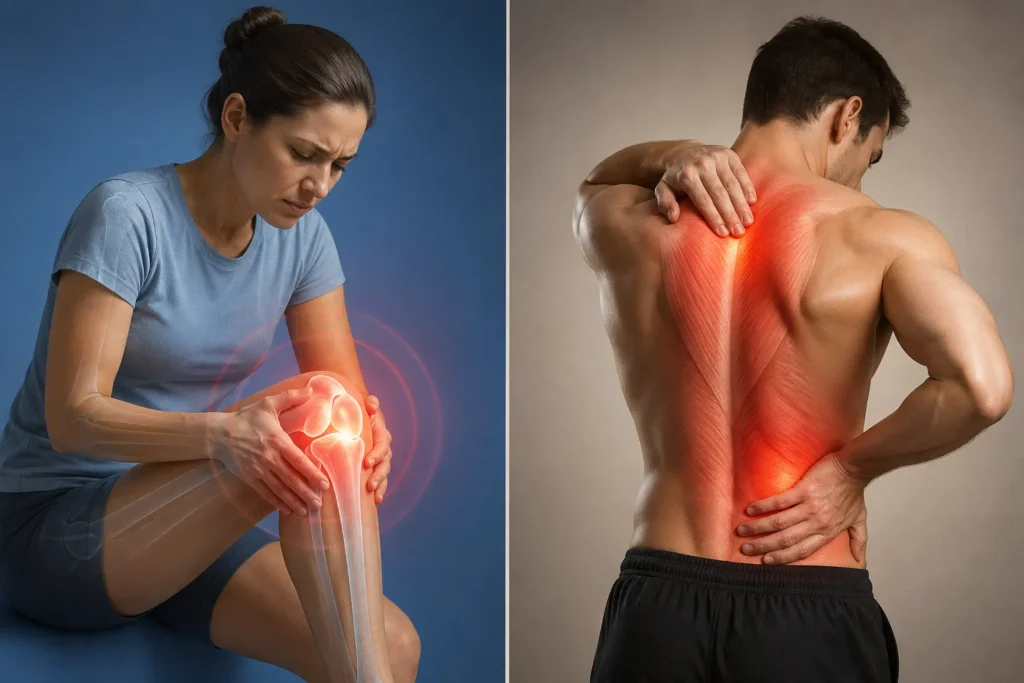
You wake up with a shoulder ache. Your knee hurts after walking, or your legs feel sore even though you haven’t exercised. Is the pain coming from a muscle, a joint, or something else?
The main difference between joint pain and muscle pain is the tissue involved. Joint pain comes from structures in or around a joint, while muscle pain originates in muscle tissue. However, the symptoms often overlap, making it difficult to identify the source based on sensation alone.
Muscle pain may feel sore, tight, or tender. Joint pain may involve stiffness, swelling, or discomfort during certain movements. But these are general patterns, not reliable diagnostic tests.
Understanding where your pain occurs, when it started, and what makes it better or worse can help you decide when to seek care. This guide explains the differences between joint pain and muscle pain, common causes, symptoms to watch for, and treatment options.
Key Takeaways
- Muscle pain often involves aching, tightness, tenderness, or soreness after activity.
- Joint pain may involve stiffness, swelling, reduced movement, or discomfort around a joint.
- Both muscle pain and joint pain can worsen with movement or occur at rest.
- Tendon, ligament, bursa, and nerve problems can cause symptoms that resemble either type of pain.
- Pain after exercise may be muscular, but pain that lasts several weeks warrants further assessment.
- Sudden severe pain in a hot, swollen joint requires urgent medical evaluation.
- Identifying the likely source of pain helps guide appropriate treatment.
Joint Pain vs. Muscle Pain: What’s the Difference?
Joint pain and muscle pain can feel remarkably similar, particularly around areas such as the shoulders, hips, knees, and back. The comparison below highlights common patterns.
| Feature | Muscle pain | Joint pain |
| Source | Muscle tissue | Structures within or around a joint |
| Typical sensation | Soreness, tightness, cramping, aching | Aching, stiffness, sharp pain, pressure |
| Location | May affect a specific muscle or larger area | Often centered around a joint |
| Tenderness | May increase when the muscle is pressed | May occur along the joint or surrounding structures |
| Movement | Often worsens when the affected muscle contracts or stretches | May worsen with joint movement or weight-bearing |
| Swelling | Possible after injury | Possible with inflammation, arthritis, or injury |
| Stiffness | Common after exercise or inactivity | Common in arthritis and certain joint conditions |
| Common causes | Strain, overuse, muscle injury, illness | Arthritis, inflammation, ligament injury, cartilage problems |
| Treatment | Depends on the cause; may involve activity modification and rehabilitation | Depends on the cause; may involve rehabilitation, medication, or targeted treatment |
Important: These distinctions are useful clues, but a person can have muscle and joint pain at the same time.
What Does Muscle Pain Feel Like?

Muscle pain, also called myalgia, occurs when muscle tissue becomes painful. It can develop after exercise, repetitive activity, injury, or prolonged physical strain. Some medical conditions and medications can also cause muscle pain.
Common Symptoms of Muscle Pain
- Aching or soreness
- Tightness
- Tenderness when touched
- Muscle cramps
- Pain during contraction or stretching
- Muscle spasms
- Temporary weakness due to discomfort
Muscle pain can affect a small area or several muscle groups.
Why Do Muscles Hurt After Exercise?
Muscle soreness after unfamiliar or strenuous exercise may be caused by delayed-onset muscle soreness, often called DOMS. This usually develops several hours after activity and may be most noticeable over the following one to three days. It commonly improves on its own.
However, severe muscle pain with marked weakness, swelling, or dark urine after intense exercise requires urgent medical evaluation because it may indicate significant muscle injury.
Can Muscle Pain Last for Months?
Yes. Although ordinary post-exercise soreness typically improves within days, muscle-related discomfort may become persistent because of injury, overuse, underlying illness, or other conditions. Don’t assume chronic pain is just a muscle strain without an appropriate assessment.
What Does Joint Pain Feel Like?

Joint pain is discomfort where bones meet. Commonly affected joints include the knees, hips, shoulders, wrists, fingers, ankles and spinal joints. Joint pain can result from arthritis, injury, inflammation or problems with surrounding structures.
Common Symptoms of Joint Pain
- Aching around a joint
- Stiffness after rest
- Swelling
- Warmth or tenderness
- Pain when bearing weight
- Reduced range of motion
- Difficulty bending or straightening a joint
- Discomfort during everyday activities
Not everyone with joint pain has visible swelling or redness.
Does Joint Pain Always Mean Arthritis?
No. Arthritis is one possible explanation, but joint pain may also result from:
- Ligament injuries
- Cartilage problems
- Meniscus injuries
- Tendon disorders
- Bursitis
- Previous trauma
- Other inflammatory conditions
How Can You Tell Whether Pain Is Coming From a Muscle or Joint?
Several observations may help you describe the symptoms to your doctor. These observations are not definitive self-diagnostic tests.
1. Notice Exactly Where the Pain Occurs
Muscle pain may involve a larger area of soft tissue, while joint pain may feel centered around a particular joint.
For example, thigh pain after exercise may be muscular. Pain centered around the knee, particularly with swelling or reduced movement, may suggest joint involvement.
However, nearby tendons, nerves, and other structures can produce similar symptoms.
2. Think About How the Pain Started
- Pain that appears after an unfamiliar workout, heavy lifting, or repeated physical activity may indicate muscle strain or soreness.
- Pain that develops gradually over months, especially with recurring joint stiffness, may suggest osteoarthritis or another joint condition.
- Sudden pain after a fall or twisting injury can involve muscles, joints, ligaments, or other tissues.
3. Check for Swelling or Warmth
Visible joint swelling may occur with arthritis, injuries, gout, or infection. Muscle injuries can also cause localized swelling, so swelling alone is not enough to determine the cause.
A suddenly hot, swollen, severely painful joint requires urgent medical assessment, especially if fever or illness is present.
4. Notice Whether the Pain Changes With Movement
Muscle discomfort may increase when the affected muscle contracts or stretches. Joint-related pain may become more noticeable with joint movement or weight-bearing. But there is considerable overlap.
For example, shoulder pain when reaching overhead could come from a rotator cuff tendon, the shoulder joint, or another structure.
5. Pay Attention to Morning Stiffness
Short periods of stiffness after inactivity can occur with both muscular and joint conditions. Prolonged morning stiffness, particularly with swelling in several joints, may suggest inflammatory arthritis. Patients with this pattern may need evaluation by primary care or rheumatology.
6. Notice Whether Tingling or Numbness Is Present
Tingling, burning, numbness, or electric-like pain may suggest nerve involvement. However, symptoms can overlap. Pain around a hip or knee may occasionally originate from the lower back or another nerve-related condition.
7. Consider How Long the Pain Has Continued
Ordinary muscle soreness after exercise often improves within several days. Joint pain associated with osteoarthritis or inflammatory conditions may persist or recur. However, duration alone does not establish the source of pain. Pain that persists, worsens over time, or interferes with daily activities warrants assessment.
Muscle Pain vs. Joint Pain vs. Nerve Pain
Sometimes the question is not simply whether pain comes from a joint or muscle. Nerve pain can produce discomfort in the same areas.
| Pain source | Common description | Other possible clues |
| Muscle | Aching, soreness, tightness, cramping | Tenderness or pain with muscle use |
| Joint | Aching, stiffness, sharp pain | Swelling, reduced motion, weight-bearing discomfort |
| Nerve | Burning, tingling, electric shocks, shooting pain | Numbness, altered sensation, weakness |
These patterns are not exclusive. A person with lumbar nerve root irritation may experience pain around the hip or leg even if that joint isn’t the primary problem. Sciatica is a common example.
Common Examples: Is It Muscle Pain or Joint Pain?
Knee Pain vs. Muscle Pain Around the Knee
Knee pain may originate from osteoarthritis, meniscus problems, ligaments, tendons, or surrounding muscles. Thigh muscle pain after exercise may be muscular. Pain centered in the knee with stiffness, swelling, or difficulty bearing weight may suggest joint-related problems.
However, tendon disorders around the knee can also cause pain during stair climbing or exercise. The location and examination findings help distinguish these causes.
Hip Joint Pain vs. Hip Muscle Pain
Hip joint problems often cause discomfort in the groin or front of the hip. Muscle or tendon problems may produce pain around the outer hip, buttock, or thigh.
However, these can overlap, and some lumbar spine conditions can cause pain in the hip region. Pain location alone cannot reliably identify the source.
Shoulder Joint Pain vs. Muscle Pain
Shoulder pain may involve the joint, rotator cuff tendons, muscles, bursae, or nerves.
For example, pain when reaching overhead may indicate rotator cuff problems or other shoulder conditions. Loss of strength, a significant injury, or persistent restriction of movement may warrant further evaluation.
Lower Back Muscle Pain vs. Spinal Joint Pain
Lower back pain can arise from muscles, spinal discs, facet joints, SI joints, or nerves. Muscle-related symptoms may involve tightness or tenderness. Facet joint-related pain may occur with certain movements, while nerve root irritation can produce symptoms extending into a leg. Movement patterns alone can’t confirm these distinctions.
What Causes Muscle Pain?
Muscle pain can have several explanations.
- Muscle Strain: A strain occurs when muscle fibers are overstretched or injured. It may develop after lifting, sports activity or an unexpected movement.
- Exercise-Related Soreness: Unfamiliar exercise or increased physical activity can cause temporary soreness.
- Repetitive Physical Demands: Repeated tasks may cause discomfort in muscles and surrounding soft tissues.
- Muscle Spasms: A muscle spasm is an involuntary contraction that may cause tightness or discomfort.
- Medical Conditions and Medications: Viral illnesses, inflammatory disorders, metabolic conditions, and certain medications can also contribute to muscle pain. Widespread or unexplained muscle pain should not automatically be attributed to overuse.
What Causes Joint Pain?
Osteoarthritis
Osteoarthritis affects the entire joint, including cartilage, bone, and surrounding tissues. It commonly affects the knees, hips, hands, and other joints. Symptoms may include pain, stiffness, and difficulty with movement. For ongoing symptoms, see these arthritis pain management options.
Rheumatoid Arthritis
Rheumatoid arthritis is an autoimmune inflammatory disease. It may cause swelling, tenderness, prolonged morning stiffness, and symptoms affecting multiple joints. It requires disease-specific medical management.
Injuries
Ligament injuries, cartilage damage, fractures, and other trauma can affect joints.
Gout and Other Inflammatory Conditions
Crystal-related arthritis, including gout, may cause episodes of intense joint pain and swelling.
Infection
Septic arthritis is a serious condition caused by infection involving a joint. It requires urgent treatment.
When Is Muscle or Joint Pain Serious?
Most uncomplicated muscle soreness and some mild joint discomfort can improve with appropriate self-care. However, certain symptoms require prompt medical attention.
Seek Urgent or Emergency Care If You Experience:
- Sudden severe pain in a hot, swollen joint
- Joint pain with fever or feeling seriously unwell
- Inability to bear weight after a significant injury
- Visible joint deformity following trauma
- Severe muscle pain with marked weakness or dark urine
- Rapidly worsening weakness or major loss of function
A hot, painful, swollen joint may indicate septic arthritis, which requires urgent assessment.
Schedule a Medical Evaluation If:
- Pain lasts longer than expected
- Symptoms repeatedly return
- Joint stiffness or swelling persists
- Movement becomes increasingly limited
- Pain disrupts sleep or daily activities
- Several joints are painful
- You develop numbness, tingling, or weakness
- Initial care is not providing adequate relief
Do not wait several weeks if new severe or rapidly worsening symptoms develop.
How Do Doctors Determine the Source of Pain?
Diagnosis may involve a medical history, physical examination, and selected tests.
Medical History
Your healthcare provider may ask:
- Where is the pain located?
- When did it begin?
- Did it follow an injury or physical activity?
- Does movement affect the discomfort?
- Is there swelling or morning stiffness?
- Are tingling or numbness present?
- Have several areas become painful?
- What treatments have you tried?
Physical Examination
The examination may assess:
- Tenderness
- Range of motion
- Muscle strength
- Joint stability
- Swelling
- Neurological findings
- Walking and functional limitations
Imaging and Laboratory Tests
Depending on the suspected condition, tests may include:
- X-rays for certain joint and bone problems
- Ultrasound for selected soft tissue and inflammatory conditions
- MRI for detailed evaluation when clinically indicated
- Blood tests for suspected inflammatory or systemic conditions
- Joint fluid analysis when infection, gout, or another inflammatory condition is suspected
Not every patient needs imaging or laboratory testing.
What Helps Muscle Pain?
Treatment depends on the cause and severity. For uncomplicated muscle soreness or strain, appropriate care may include:
- Temporary modification of aggravating activities
- Gentle movement within comfortable limits
- Gradual return to normal activity
- Heat or ice for short-term comfort
- Physical therapy when indicated
- Appropriate medication after considering medical history
Severe injuries or persistent symptoms may require further assessment.
What Helps Joint Pain?
Joint pain treatment depends on the diagnosis. For selected conditions, options may include the following:
Physical Therapy and Exercise
Exercise-based rehabilitation may help improve strength, joint function, and mobility. Wondering how rehab compares with other approaches? See physical therapy vs. pain management.
Activity Modification
Adjusting activities and gradually building tolerance may reduce symptoms in some patients.
Medication
Certain topical or oral anti-inflammatory medications may help selected patients, although potential risks must be considered. Inflammatory arthritis may require specialized disease-modifying treatment from a rheumatologist.
Joint Injections
For selected patients with persistent joint-related pain, injections may provide temporary symptom relief. Effectiveness depends on the joint, diagnosis and medication used. They do not restore cartilage or cure arthritis.
Nerve Blocks and Radiofrequency Procedures
Certain patients with persistent joint-related pain may be considered for targeted nerve procedures, such as peripheral nerve blocks or radiofrequency ablation. For example, genicular nerve procedures may be evaluated for selected patients with chronic knee pain. These are not routine treatments for every painful joint.
When Should You See a Pain Management Specialist?
A pain management specialist may help when persistent symptoms interfere with everyday activities despite appropriate initial care. A consultation may be useful when:
- Joint or muscle-related pain remains persistent
- Conservative care has not provided sufficient improvement, such as when physical therapy is not helping
- Symptoms repeatedly return
- Pain affects walking, working, or sleeping
- Nerve involvement is suspected
- Previous testing has not fully explained the symptoms
- A clinician recommends evaluation for targeted interventional treatment
Not every patient needs a pain management procedure. People with suspected inflammatory arthritis, acute injuries, infection, or other specific conditions may need different specialist care.
Joint and Musculoskeletal Pain Evaluation in Lafayette, LA
If persistent joint or musculoskeletal pain is interfering with your daily life, identifying the possible source is an important first step.
At Interventional Pain Specialists (IPS), Dr. Albert Gros, Jr. and the team evaluate patients with persistent joint, spinal, nerve-related, and other pain conditions. Dr. Gros is double board-certified in anesthesiology and pain medicine and has more than two decades of experience. Treatment recommendations depend on the diagnosis, examination findings, previous care, and individual goals.
Patients searching for a pain management doctor in Lafayette, LA can learn about the clinic’s services and providers.
Joint Pain Treatment in Lafayette
We evaluate knee, hip, shoulder, and other joint-related pain and may discuss appropriate interventional options when indicated. Learn more about joint pain treatment in Lafayette, LA.
Interventional Pain Specialists – Lafayette
1101 S. College Rd., Suite 200
Lafayette, LA 70503
Phone: (337) 362-8101
Joint Pain Treatment in Opelousas
We also provide pain management services for patients in Opelousas and nearby communities. Learn more about evaluation, treatment options, and appointments for joint pain treatment in Opelousas, LA.
Interventional Pain Specialists – Opelousas
3983 I-49 S. Service Road
Opelousas, LA
Phone: (337) 284-3200
Request a Pain Management Consultation
If pain continues despite appropriate initial care or significantly interferes with daily activities, contact us to discuss whether a pain management evaluation is suitable.
IPS provides specialist pain management care and does not replace emergency treatment for infection, serious injuries, or other urgent conditions.
Frequently Asked Questions
How do I tell if my pain is muscular or joint-related?
Muscle pain often involves soreness, tightness, or tenderness, while joint pain may involve stiffness, swelling, or discomfort centered around a joint. However, the symptoms overlap, so a clinical examination may be necessary.
What is the biggest difference between muscle pain and joint pain?
The main difference is where the discomfort comes from. Muscle pain originates in muscle tissue, while joint pain involves structures within or around a joint.
Does joint pain feel deeper than muscle pain?
Sometimes, but not always. Muscle pain can feel deep, and joint pain can be tender near the skin. Pain depth is not a reliable diagnostic test.
Can muscle pain cause swelling?
Yes. Muscle injuries can produce swelling, bruising, and tenderness. Swelling is not exclusive to joint conditions.
Is it arthritis or muscle pain?
Arthritis may cause joint stiffness, swelling, or pain with movement. Muscle soreness often follows physical activity or injury. A medical evaluation can help distinguish between them.
Why do my knees hurt after exercising?
Knee pain after exercise can involve the joint, tendons, surrounding muscles, or other structures. Symptom location, activity type, swelling, and exam findings can help clarify the cause.
Why does my hip hurt when I walk?
Hip pain can originate from the joint, nearby muscles or tendons, or the lower back. Location alone does not establish a diagnosis.
Can muscle pain turn into joint pain?
Muscle pain does not automatically transform into joint disease. However, muscles and joints work together, and injuries or changes in movement may affect surrounding structures. Persistent symptoms should be evaluated.
Does arthritis hurt more at rest or during movement?
It depends on the type of arthritis. Osteoarthritis often causes discomfort during activity and stiffness after rest. Inflammatory arthritis may cause prolonged morning stiffness and symptoms that improve with movement.
How can I tell whether pain is coming from a nerve?
Burning, electric-like pain, numbness, tingling, or pain following a particular path may suggest nerve involvement. These symptoms still require medical evaluation to determine the cause.
How long should muscle soreness last?
Typical post-exercise soreness often improves within a few days. Persistent, severe, or unexplained muscle pain may require medical assessment.
When should I worry about joint pain?
Seek urgent care for sudden severe pain in a hot, swollen joint, particularly with fever or illness. Persistent swelling, worsening movement, or repeated episodes of joint pain also warrant evaluation.
Should I see a pain management doctor for muscle or joint pain?
A pain specialist may help with selected persistent pain conditions that have not improved despite appropriate initial treatment. Acute injuries, inflammatory arthritis, or suspected infections may require other medical care first.
Medical References
- National Institute of Arthritis and Musculoskeletal and Skin Diseases: Osteoarthritis
- NIAMS: Rheumatoid Arthritis
- MedlinePlus: Muscle Aches
- Mayo Clinic: Joint Pain
- Mayo Clinic: Septic Arthritis
- Centers for Disease Control and Prevention: Arthritis
Medical Disclaimer
This article is for educational purposes only and does not replace professional medical advice, diagnosis, or treatment. Muscle, joint, tendon, and nerve-related conditions can cause overlapping symptoms. Seek urgent medical attention if you suspect a joint infection, serious injury, or other concerning symptoms.