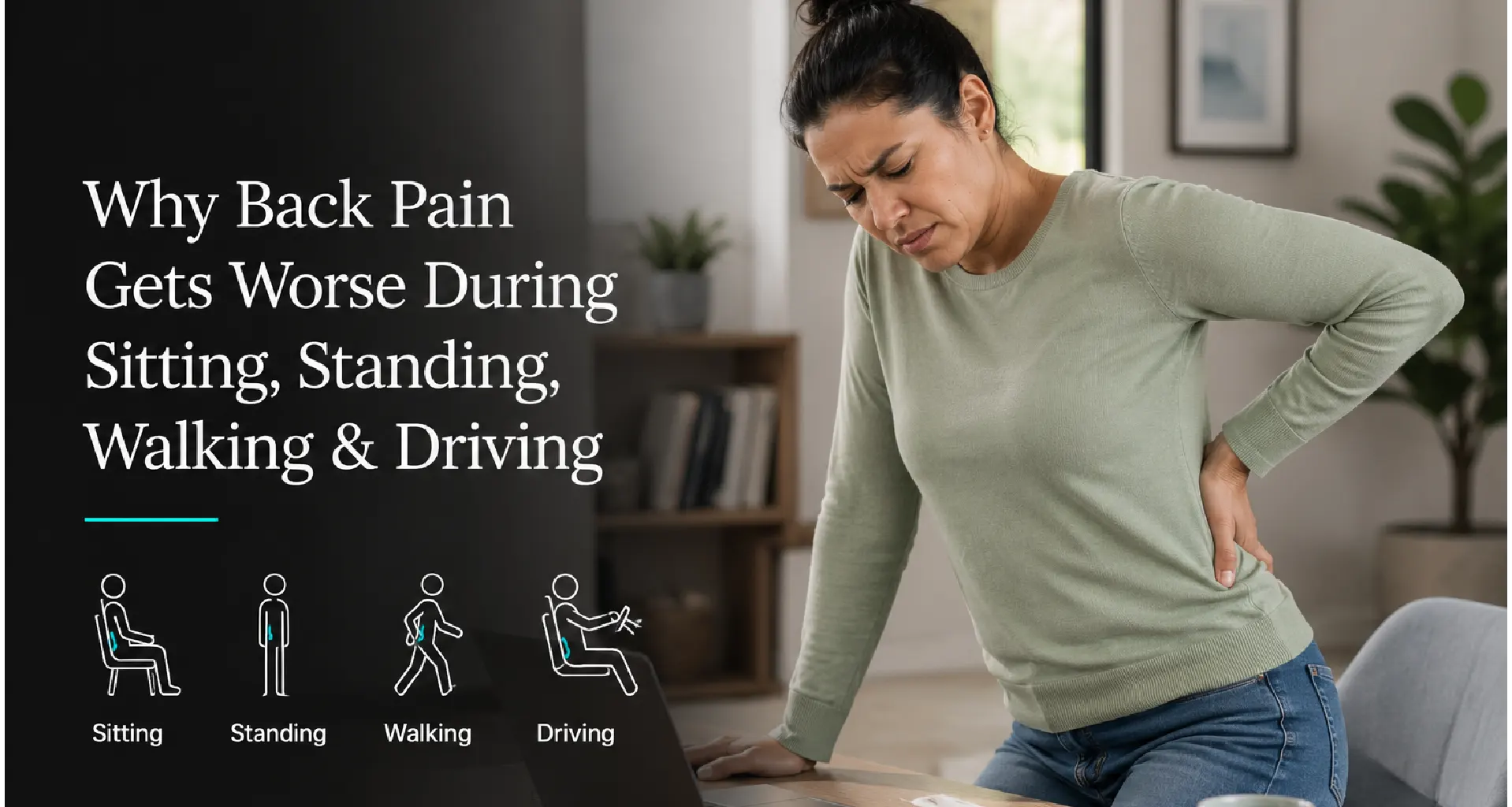
One of the most important clues to the cause of your back pain isn’t where it hurts.
It’s when it hurts.
Many patients focus entirely on the location of pain:
- “My lower back hurts.”
- “My right side hurts.”
- “My back aches all day.”
But pain specialists often pay just as much attention to what makes the pain worse.
For example:
- Back pain that worsens while sitting may have a different cause than pain that worsens while standing.
- Pain that appears while walking may indicate a different condition than pain triggered by driving.
- Some patients feel relief when sitting but struggle to stand.
- Others hurt while sitting and feel better when moving.
These patterns can provide valuable clues about what’s happening inside the spine.
In this guide, you’ll learn:
- Why activity-related pain matters
- What sitting-related back pain may indicate
- Why standing sometimes makes pain worse
- Common causes of walking-related pain
- Why driving can trigger back pain
- When symptoms suggest it’s time to seek treatment
Quick Answer: What Does It Mean When Certain Activities Make Back Pain Worse?
Different spinal structures respond differently to movement and position.
For example:
| Activity | Possible Pain Sources |
| Sitting | Herniated disc, degenerative disc disease, sciatica |
| Standing | Facet joint arthritis, SI joint dysfunction |
| Walking | Spinal stenosis, facet arthritis, SI joint dysfunction |
| Driving | Disc problems, sciatica, poor spinal positioning |
| Bending Forward | Disc-related pain |
| Leaning Backward | Facet joint pain |
While symptoms alone cannot provide a diagnosis, they often help narrow down potential causes.
Why Does My Back Hurt When Sitting?
One of the most common complaints pain specialists hear is:
“I can stand and walk, but sitting kills my back.”
This symptom frequently points toward disc-related pain.
When sitting:
- Pressure inside spinal discs increases
- The lower spine flexes forward
- Irritated discs may become more painful
- Nerve compression may worsen
If you’re experiencing persistent discomfort while sitting, learning more about why your lower back hurts can help you better understand the potential causes.
Common causes include:
1. Herniated Disc
A herniated disc may become more symptomatic while sitting because sitting increases pressure on the damaged disc.
Common symptoms include:
- Lower back pain
- Leg pain
- Sciatica
- Tingling
- Numbness
2. Degenerative Disc Disease
Degenerated discs often tolerate standing better than prolonged sitting.
Patients frequently report:
- Aching pain after sitting
- Stiffness when standing up
- Pain during long workdays
3. Sciatica
Sitting may increase irritation of the sciatic nerve.
Patients often experience:
- Pain into the buttocks
- Leg pain
- Tingling
- Burning sensations
Related: Sciatica: Symptoms, Causes & Non-Surgical Treatment
Why Does My Back Hurt When Standing?
Some patients experience the exact opposite pattern.
They feel relatively comfortable sitting but develop worsening pain while standing. This commonly suggests joint-related pain.
Facet Joint Syndrome
Facet joints are small joints located in the spine.
Standing increases pressure on these joints.
Common symptoms include:
- Lower back pain
- Morning stiffness
- Pain while standing
- Pain while twisting
Many patients feel relief shortly after sitting down.
Facet Arthritis
Arthritic facet joints often become more painful during prolonged standing.
Symptoms may worsen during:
- Cooking
- Shopping
- Waiting in line
- Yard work
SI Joint Dysfunction
The SI joints connect the spine and pelvis.
Standing may increase stress on these joints.
Common symptoms include:
- One-sided lower back pain
- Buttock pain
- Hip pain
- Pelvic discomfort
Learn More: SI Joint Dysfunction Explained
Why Does My Back Hurt When Walking?
Walking is generally considered healthy for the spine.
However, certain conditions become more noticeable during walking.
Spinal Stenosis
One of the classic signs of spinal stenosis is:
Pain while walking that improves when sitting.
As nerves become compressed during upright activity, symptoms may include:
- Lower back pain
- Leg pain
- Numbness
- Weakness
Many patients find themselves needing frequent breaks while walking.
Facet Joint Arthritis
Facet joints may become increasingly irritated during prolonged walking.
Patients often notice:
- Gradually worsening pain
- Stiffness
- Reduced walking tolerance
SI Joint Dysfunction
Walking places repeated stress on the SI joints.
Inflammation may lead to:
- Lower back pain
- Hip pain
- Buttock pain
Why Does My Back Hurt While Driving?
Driving combines several factors that commonly aggravate spinal pain.
These include:
- Prolonged sitting
- Vibration
- Limited movement
- Poor posture
- Increased disc pressure
Many patients notice pain during:
- Daily commutes
- Road trips
- Long periods behind the wheel
People who develop symptoms after a collision may also benefit from understanding the causes of lower back pain after a car accident.
Disc Problems
Driving often aggravates:
Because of sustained sitting pressure.
Sciatica
The seated position may increase sciatic nerve irritation.
Common symptoms include:
- Buttock pain
- Leg pain
- Tingling
- Burning sensations
Muscle Fatigue
Long drives may contribute to:
- Muscle tension
- Poor posture
- Spinal stiffness
Particularly in patients with weak core support.
Why Does Back Pain Feel Better After Sitting?
This pattern provides another important clue.
Patients who improve while sitting often have:
- Facet Joint Pain: Sitting reduces pressure on spinal facet joints.
- Spinal Stenosis: Leaning forward slightly while sitting may temporarily open spaces around compressed nerves.
- Certain Arthritic Conditions: Joint stress decreases when body weight is removed from the affected structures.
Why Does Back Pain Feel Better After Walking?
Some patients experience the opposite pattern.
Movement often helps:
- Muscle Stiffness: Gentle activity improves circulation and flexibility.
- Mild Arthritis: Many arthritic joints feel better once they “warm up.”
- Prolonged Sitting-Related Pain: Movement helps reduce stiffness caused by inactivity.
Why These Patterns Matter for Diagnosis
Patients often assume: “Back pain is back pain.”
In reality, the timing of symptoms often provides critical diagnostic information.
For example:
Patient A
Pain while sitting.
Possible causes:
- Herniated disc
- Sciatica
- Disc degeneration
Patient B
Pain while standing.
Possible causes:
- Facet arthritis
- SI joint dysfunction
Patient C
Pain while walking.
Possible causes:
- Spinal stenosis
- Facet syndrome
These patterns help pain specialists identify likely pain generators before recommending treatment.
When Should You Worry About Activity-Related Back Pain?
Most back pain is not dangerous.
However, medical evaluation is recommended if:
- Pain lasts more than a few weeks
- Symptoms continue worsening
- Leg pain develops
- Numbness or tingling occurs
- Weakness develops
- Walking becomes difficult
- Sleep is affected
- Daily activities are becoming limited
If symptoms become persistent, it may be helpful to learn more about chronic lower back pain, its causes, symptoms, and treatment options.
How Pain Specialists Identify the Cause
Evaluation typically includes:
Medical History
Questions often focus on:
- What activities trigger pain
- When symptoms began
- Previous injuries
- Daily limitations
Physical Examination
Assessing:
- Strength
- Flexibility
- Joint function
- Neurological status
Imaging Studies
Depending on symptoms:
- MRI
- X-rays
- CT scans
May help identify structural causes.
Diagnostic Injections
Targeted injections can help determine whether pain is coming from:
- Facet joints
- SI joints
- Nerves
- Other spinal structures
This often helps guide treatment decisions.
Non-Surgical Treatment Options
Treatment depends on the underlying cause.
Many patients with long-lasting symptoms explore non-surgical treatments for chronic back pain before considering surgery. Options may include:
Physical Therapy
To improve:
- Strength
- Mobility
- Flexibility
- Posture
Epidural Steroid Injections
Commonly used for:
- Sciatica
- Herniated discs
- Nerve compression
Learn how an epidural steroid injection for back pain may help some patients avoid surgery:
Facet Joint Injections
Used when spinal arthritis contributes to symptoms.
SI Joint Injections
Helpful for SI joint dysfunction.
Radiofrequency Ablation (RFA)
Often used for:
- Facet joint pain
- SI joint pain
Many patients experience relief lasting several months or longer.
Back Pain Treatment in Lafayette, LA
At Interventional Pain Specialists, we help patients throughout Lafayette and surrounding Louisiana communities identify the true cause of chronic back pain.
By understanding how pain changes during sitting, standing, walking, and driving, our team can often narrow down the source and create a more targeted treatment plan.
Treatment options may include:
- Physical rehabilitation
- Epidural steroid injections
- Facet joint procedures
- SI joint injections
- Radiofrequency ablation
- Comprehensive chronic pain management
Our goal is to help patients move more comfortably, stay active, and avoid unnecessary surgery whenever possible.
Frequently Asked Questions
Why does my back hurt more when sitting than standing?
This commonly suggests disc-related pain, including herniated discs, degenerative disc disease, or sciatica.
Why does my back hurt when standing but feel better when sitting?
Facet joint arthritis and SI joint dysfunction are common causes of this pattern.
Why does walking make my back hurt?
Walking-related pain may be associated with spinal stenosis, facet joint arthritis, or SI joint dysfunction.
Why does driving trigger back pain?
Driving combines prolonged sitting, vibration, limited movement, and increased disc pressure, which may aggravate spinal conditions.
What is the most common cause of lower back pain?
Muscle strain is the most common cause, but persistent pain may involve discs, joints, nerves, or spinal arthritis.
Medical References
- National Institute of Neurological Disorders and Stroke (NINDS)
- American Academy of Orthopaedic Surgeons (AAOS)
- Mayo Clinic – Back Pain
- Cleveland Clinic – Lower Back Pain
- North American Spine Society (NASS)
- National Institute of Arthritis and Musculoskeletal and Skin Diseases (NIAMS)
- American Society of Interventional Pain Physicians (ASIPP)
Disclaimer
This article is for educational purposes only and should not be considered medical advice. Always consult a qualified healthcare professional regarding diagnosis and treatment recommendations.